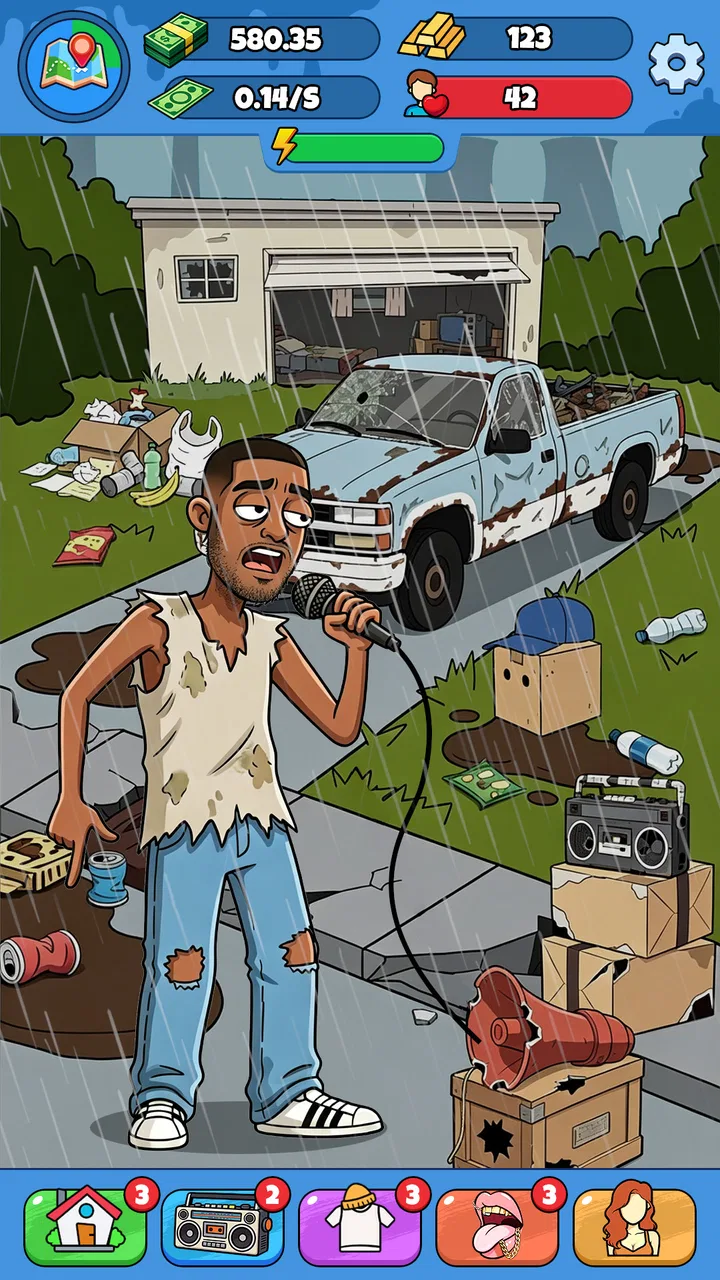
Rap Star:Idle Clicker
- 4.8
- Rating
- 5.00M
- Installs
- Free
- Price

 Analysis by App-foxy
I went into Rap Star:Idle Clicker expecting a quick tap-and-wait game, and that is exactly where its appeal begins. The fantasy is straightforward: start with very little, build income through repeated taps, turn attention into popularity, and chase the glamorous side of a rap career. It is a light simulation game rather than a serious music-making tool, so the fun comes from watching a fictional career grow instead of composing tracks or managing a detailed recording studio.
My first sessions felt easy to understand. The game puts the central earning action in front of you, then wraps it in the broader dream of becoming known. That combination makes it approachable when I only have a few minutes, while the progression gives me a reason to check back later. The mood is playful and flashy, but the underlying loop remains simple enough that I never needed a tutorial-heavy explanation to understand what I was doing.
DragonflyEntertainment presents the game as a free simulation experience for players who enjoy incremental progress, celebrity themes, and casual interaction. It is available for Android devices running version 7.0 or later, and the current version is 307.0.5. The game carries a Teen age rating, which is worth noticing because its presentation leans into dating, fame, and suggestive pop-culture imagery rather than keeping everything suitable for young children.
You May Also Like

 Blood Strike: 2.5 Anniversary
Blood Strike’s Loadouts Turn Every Drop Into a Tactical Gamble
A close look at Blood Strike’s custom loadouts: how fast access to signature weapons reshapes its battle royale rhythm, rewards preparation, and narrows the gap between fights.

 Pandora - Music & Podcasts
Pandora’s Music Is Easy to Start, but Harder to Recover
Pandora’s strength is its low-effort path from a seed to a station. Its weak spot is how much confidence it asks you to place in connection, setup, and quiet recovery.

 8 Ball Pool
 Is Built on Rivalries, Rematches, and Routine
A close look at the rivalries, rematches, shared routines, and unanswered safety questions that turn a quick pool match into a persistent mobile community.

 Samsung Music
’s Quiet Strength Is Playing What You Already Own
Its reach comes less from spectacle than from dependable access to a personal library. That simplicity is both the app’s strongest retention engine and its ceiling.

 AccuWeather: Weather Radar
AccuWeather Review: A Quick, Clear Forecast for Everyday Decisions
For everyday plans, the best forecast is the one you can understand quickly. AccuWeather makes rain timing, radar, and local conditions easy to act on, with a few trade-offs.

 Hill Climb Racing
Why Hill Climb Racing Still Turns Crashes Into One More Run
A tiny car, a bumpy hill and one more upgrade: Hill Climb Racing keeps resurfacing because its simple chaos makes every near-miss feel personal.
More From Our News Desk



From quick taps to a playable rap-career mood
I use this section to look at how the game turns a few quick taps into a recognizable career fantasy, and where its rap-star setting adds more than decoration. I’ll also weigh the simplicity that makes it easy to pick up against the repetition that can eventually test a player’s patience.
The opening works because the goal is instantly readable
The strongest part of the first impression is clarity. I do not have to learn a complicated control scheme or understand a large map before the premise makes sense. Tap-based earnings provide immediate feedback, and the rags-to-riches setup gives those taps a purpose. Even when the action is repetitive, the idea of moving from an unknown performer toward a more visible career helps the routine feel connected to a larger story.
That simplicity also defines the game’s limits. Players looking for deep songwriting, realistic business decisions, or a demanding management simulation will probably find the opening too shallow. The experience is designed around momentum and small improvements, not around mastering a difficult system. I would recommend it to someone who likes watching numbers and status rise gradually, but not to a player who wants the creative control of a full music-production game.
The free entry point makes it easy to try without committing money first. In-app purchases range from $0.99 to $99.99 per item, so I would approach the store carefully and decide in advance whether I am comfortable spending. The basic loop is the part to test before buying anything: if tapping, waiting, and upgrading do not feel satisfying on their own, paid boosts are unlikely to transform the game into a different kind of experience.
A visual language built around ambition rather than realism
The setting is less interested in reproducing the difficult details of the music industry than in presenting a recognizable fantasy of success. Fame, money, romance, and public attention form the game’s visual vocabulary. That choice gives the world a bright, exaggerated tone. I read it as a playful version of celebrity culture, where progress is communicated through status and presentation rather than through a realistic account of contracts, touring, or studio work.
This matters because the art direction supports the idle format. A highly realistic world would raise questions the mechanics could not answer. Instead, the stylized approach lets the game move quickly from one achievement to the next. The setting acts like a visual reward system: the more successful the character becomes, the more the fantasy of recognition takes over from the humble beginning.
The dating element fits that same language, although it may not suit everyone. It is part of the game’s idea of a successful lifestyle, not a separate relationship simulator with the emotional depth of a narrative adventure. I found it more useful as atmosphere and motivation than as a reason to play by itself. Anyone uncomfortable with the game’s flirtatious framing should know that the celebrity fantasy is central to its identity, not a minor decoration.
Why the sound and pacing matter more than they first appear
In a tapper, pacing can make the difference between a relaxing routine and a tedious chore. Rap Star:Idle Clicker understands that the player needs frequent signs of movement. Tapping creates a direct rhythm, while the broader rise in status gives the session a sense of direction. I did not approach it as a music game, because the interaction is not about performing beats or arranging a track. Instead, the rap theme supplies the attitude and context for an incremental progression loop.
The sound design works best when it reinforces that attitude without demanding too much attention. I can play in short bursts and keep the game’s mood in the background, which suits an idle title. It is the kind of experience I would open while taking a break, waiting for an appointment, or winding down after work. The presentation does not ask me to sit forward with the concentration required by a rhythm game, and that is an important distinction.
There is a trade-off here. Because the mechanics are intentionally repetitive, the sound and visual energy cannot hide the routine forever. A player who needs constant musical variety may lose interest once the initial novelty fades. I found that the game works better when treated as a small daily habit than as a long uninterrupted session. Its pacing rewards returning at sensible intervals rather than forcing myself to grind through every available action at once.
How the idle structure fits the theme
The central mechanical fit is convincing: a rising rap career is represented through repeated earning, gradual accumulation, and the feeling that attention can keep producing results. That is a natural match for idle design. I am not expected to personally perform every part of the career, so the game can suggest a growing operation while keeping my input limited to taps and decisions around progress.
For me, the most useful way to play is to separate active moments from passive progress. When I have a minute, I focus on the immediate earning action and inspect what has changed. When I am busy, I let the game function as a background progression experience and return later. This avoids the common mistake of treating an idle game like an action game, where constant input is supposed to remain exciting for hours.
A practical everyday scenario would be opening it during a short commute break. I can make a few taps, check whether the character’s progress has reached a useful point, and close the game without losing the sense that the career is moving forward. It also suits players who enjoy checking a project several times during the day, especially if they like the small satisfaction of seeing a modest gain become a more noticeable one.
Where the loop may create friction
The same structure that makes the game accessible can also make it feel narrow. Tapping and waiting are satisfying only when the rewards arrive at a pace that feels meaningful. If progress slows too sharply, the fantasy of momentum can turn into maintenance. I would pay attention to that feeling during the first several sessions. If I start opening the game only to repeat the same action without a clear new goal, that is a sign the loop is no longer matching my expectations.
The purchase range also changes how I evaluate progression. A free game with optional items can be perfectly enjoyable, but I prefer to treat purchases as a convenience rather than a requirement. My advice is to play long enough to understand the normal rhythm before spending. That gives me a better sense of whether an item solves a genuine annoyance or merely encourages me to skip the part of the game I was supposed to enjoy.
Another trade-off is thematic rather than mechanical. The game’s version of success focuses on money, visibility, and romantic attention. That is coherent, but it is not a broad portrait of artistic achievement. Players who want lyrical creativity, collaboration, or the less glamorous work behind a music career may prefer a management game with deeper decisions. Here, the fantasy is intentionally compressed into a bright, fast-moving climb.
Who will get the most from it
I think the best audience is someone who likes casual simulation games with a clear fantasy and low learning pressure. If you enjoy incremental games, celebrity-themed progression, or checking in on a growing virtual career, the design is easy to appreciate. The average rating of 4.7 from around 31 thousand ratings and an install count above one million suggest that this straightforward formula has found a substantial audience, although popularity alone does not guarantee that its repetitive pace will suit every player.
It is also a reasonable choice for someone who wants a game that can be played in fragments. I would not need a long uninterrupted evening to get value from it. The combination of immediate tapping and longer-term progress makes it more flexible than a conventional story game, where stopping after a few minutes can feel unsatisfying.
I would skip it if I am searching for a genuine rap simulator, a deep relationship story, or a competitive rhythm challenge. The short description, “Rap Star,” points toward the theme, but the actual appeal is the idle-career structure around that theme. Players should choose it for the progression fantasy first and the music setting second.
How it compares with familiar alternatives
Compared with a traditional music game, this title asks much less from my timing and creativity. I am not judged on whether I can follow a beat, and I am not building a song note by note. That makes it more relaxing, but also less expressive. A rhythm game is better when I want active concentration and musical challenge; this one is better when I want a career fantasy that keeps moving with light input.
Compared with a deeper tycoon or management simulation, the game is more immediate and less demanding. I do not have to study a large economy before I can see the point of the next action. The cost is that the decisions may feel less substantial than those in a game built around staffing, scheduling, budgets, or long-term strategy. I would choose this title for accessibility and mood, not for complex planning.
It also differs from a narrative celebrity adventure. A story-led alternative might give relationships and personal choices more emotional weight, while this game uses those ideas as part of an upward progression. That makes the experience lighter and more repeatable, but it can leave players wanting richer character development. Knowing that distinction before downloading saves disappointment.
Small habits that improve the experience
My first tip is to decide what kind of session I am having. For a short visit, I focus on the clearest immediate action rather than trying to optimize every possible improvement. For a longer visit, I look at the relationship between active tapping and the progress that accumulates while I am away. This simple separation keeps the game from feeling like I am constantly doing the same task without purpose.
My second tip is to judge upgrades by how they change the rhythm, not only by their price or apparent size. An improvement that makes progress feel more visible may be more valuable to my enjoyment than one that looks impressive but leaves the pacing unchanged. In an idle game, comfort and momentum are part of the reward, even when they are not presented as dramatic achievements.
My third tip is to keep the Teen rating in mind when choosing who can play it. The combination of fame, dating, and suggestive celebrity imagery makes it a better fit for older players than for children. I would also avoid presenting it as an educational music app: its value is entertainment, mood, and casual progression.
Finally, I would resist turning the game into a spending contest with myself. Because the purchase options extend from small amounts to much larger individual items, setting a personal limit before playing is sensible. The most enjoyable version of the experience is the one where I remain interested in the climb itself, rather than feeling pressured to buy my way past every slower section.
My atmosphere verdict
Rap Star:Idle Clicker succeeds when its art direction, celebrity setting, and relaxed pacing work together to make a simple loop feel like a miniature rise to fame. I like that the game does not pretend to be a full music-production experience. It uses rap culture as a colorful frame for incremental progress, and that honesty makes the design easier to understand.
There are clear limitations. The repeated actions may not hold the attention of players who need constant novelty, and the dating-and-fame presentation will not appeal to everyone. The purchase structure also deserves a cautious approach, especially for anyone who is sensitive to progression shortcuts. Those are not minor details; they shape whether the game feels like a pleasant habit or an overly repetitive wait.
Still, I can recommend it to the right person. If I want a free simulation game that lets me check in briefly, build a fictional rap career, and enjoy a bright rags-to-success atmosphere without learning a complicated system, this is a good fit. DragonflyEntertainment has kept the mechanics accessible while giving them a recognizable mood. The key is to play it as a relaxed career-building idle game, not as a deep music simulator.
FAQs for Rap Star:Idle Clicker
01What is Rap Star: Idle Clicker about?
Rap Star: Idle Clicker is a music-themed simulation game where players take on the role of an aspiring rap artist. The goal is to build your career from the ground up, releasing tracks, gaining fans, and earning money. The game combines idle mechanics with strategic decision-making to grow your music empire.
02Is Rap Star: Idle Clicker free to play?
Yes, Rap Star: Idle Clicker is free to download and play. However, it offers in-app purchases that allow players to buy virtual currency and other enhancements. These purchases can expedite progress but are not necessary to enjoy the game fully.
03What platforms is Rap Star: Idle Clicker available on?
Rap Star: Idle Clicker is available on both Android and iOS platforms. You can find the game on the Google Play Store for Android devices and the Apple App Store for iOS devices. Ensure your device meets the minimum system requirements for optimal performance.
04How does the idle mechanic work in the game?
The idle mechanic in Rap Star: Idle Clicker allows your rap career to progress even when you're not actively playing. Your artist will continue to earn fans and money while offline. When you return to the game, you can collect these resources and use them to further expand your career.
05Are there social features in Rap Star: Idle Clicker?
Yes, Rap Star: Idle Clicker includes social features that let you connect with friends. You can compete on leaderboards, share achievements, and even collaborate with friends' artists. These features add a competitive and community-driven aspect to the gameplay experience.
Pros
- Engaging gameplay with simple mechanics.
- Offline play available without data.
- Frequent updates with new features.
- Visually appealing graphics and themes.
- Addictive progression system keeps players hooked.
Cons
- In-app purchases can be quite pricey.
- Repetitive tasks may become tedious.
- Limited character customization options.
- Advertisements can interrupt gameplay.
- Some features locked behind paywalls.

Rap Star:Idle Clicker
Gallery